Why Patient Trust in Healthcare Is Declining and What It Means for Healthcare Marketing
Patients and caregivers have more access to health information than ever before. From AI tools and search engines to social media, news outlets, and advertising, healthcare information is always at their fingertips.
Yet, despite this flood of information, patient confidence is falling.
According to the 2026 Edelman Trust Barometer Special Report on Trust and Health:
- Patient confidence declined in 14 out of 16 global markets
- In the U.S., confidence in making informed health decisions dropped 14% year over year
Health care providers, institutions and life science professionals are competing with AI, peers, and other less credentialed sources to influence clinical and lifestyle decisions and it is overwhelming patients.
Patients Want Understanding
Healthcare professionals make great efforts to educate patients, yet often find those efforts falling short. That’s because trust is often shaped by how patients feel. And right now, many patients do not feel heard.
According to the Edelman study, the #1 thing patients say healthcare professionals can do to increase trust and encourage action is “understand me and my life situation.”
Helping patients feel understood is a challenge that spans the entire healthcare ecosystem. While advertising alone cannot solve the broader trust problem, it can play an important role in making healthcare communication feel more relevant, personal, and human.
Give Patients a Voice in Advertising
One way healthcare advertisers can build trust is by creating more opportunities to listen to patients and caregivers.
Some healthcare brands use digital ads for two-way communication, enabling patients to voluntarily share:
- Treatment satisfaction
- Symptoms or concerns
- Stage in their healthcare journey
- Topics they want to learn more about
The data is collected anonymously (no PII) and simply informs the experience. These insights help brands deliver more relevant education instead of showing every patient the same message. For example:
- A dissatisfied patient may want information about other treatment options
- A newly diagnosed patient may need foundational education
- A caregiver may be looking for practical support resources
The goal is to create healthcare communication that feels less authoritative or aspirational and more helpful, empathetic, and aligned with patient needs.
Improving Messaging Without Overcomplicating MLR
One concern healthcare marketers often raise is that more personalized communication could make the MLR review process significantly more complex.
Because of this, many brands start their campaign with simple feedback experiences. These experiences are not heavily branded and don’t pitch specific benefits or claims; instead they are strictly about listening to and learning from different audience segments. This helps them do two things:
- Understand patient concerns to inform creative strategy
- Define niche patient groups most in need of their specific treatment
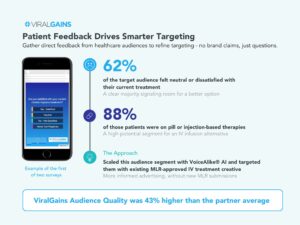
For example, one pharma advertiser discovered that:
- 62% of their target audience felt neutral or dissatisfied with their current treatment.
- Among those patients, 88% were using pill or injection-based therapies.
Because the brand offered an IV infusion treatment option, this insight helped identify a high-potential audience segment for existing MLR-approved educational creative focused on IV treatment awareness.
The result was more informed advertising rooted in real patient feedback.
Understanding Is the New Healthcare Marketing Advantage
Patients are more likely to engage with healthcare communication that feels:
- Educational instead of promotional
- Personalized instead of generic
- Authentic instead of automated
- Human instead of transactional
This is especially important as AI-generated content becomes more common because the more automated information patients encounter, the more valuable human understanding may become.
To build trust, healthcare brands should create experiences that make patients feel heard and understood. While advertising alone cannot rebuild trust in healthcare, it can contribute to a healthcare experience that feels more relevant, responsive, and human.
Learn more about how healthcare marketers are using patient feedback to create more relevant, trusted advertising experiences: