
The Geography of Care: Finding the Gaps in Patient Access and Experience
Pharma marketers strive to reach the right patients with their ad campaigns, however, two patients with the same diagnosis may have very different healthcare experiences depending on their location.
For example, one patient may live near a major medical center with specialists who regularly treat their condition. Another may live hours from the nearest specialist. Yet healthcare advertisers are likely to treat these patients as virtually identical. That’s why geography deserves a bigger role in healthcare advertising strategy.
Look Beyond Patient Prevalence
To better understand market opportunity, marketers should consider a variety of factors:
- Disease & symptom prevalence: Where are patients with a particular condition most concentrated?
- Diagnosis and treatment patterns: How does treatment utilization vary by region?
- Prescribing activity: Where are healthcare providers prescribing therapies within a particular treatment category?
- Access to care: Are relevant specialists and treatment centers available nearby?
Together, these signals can help brands identify where opportunities and barriers to care may exist.
Case Study: How Geography Can Influence Patient Satisfaction
Geography influences whether patients can access treatment and can shape how they feel about their care.
In one VG Health campaign, a pharmaceutical brand was using online video and display ads to educate patients about a medication administered intravenously (IV) at an infusion center. When the VG Health team analyzed patient-reported treatment satisfaction by geographic region, an interesting pattern emerged: Higher patient satisfaction was associated with greater proximity to infusion centers. Patients located farther from infusion centers tended to report lower satisfaction.
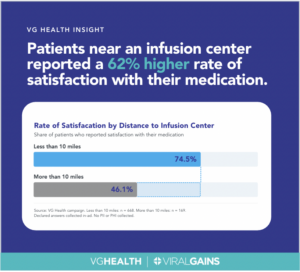
More than 450 rural hospitals in the US have eliminated specialized infusion and chemotherapy services [1] and our survey shows the direct human cost of that distance: patients living more than 10 miles from an infusion center reported a much lower rate of satisfaction with their treatment (46.1% vs. 74.5%).
The finding highlighted an important consideration: Even when a treatment is clinically appropriate, the logistics of receiving it can influence the patient experience.
For pharmaceutical and healthcare marketers, insights like these can help inform both audience strategy and messaging. Patients living near infusion centers may have different educational needs than those facing longer travel distances or more complicated treatment logistics.
And with 80% of rural America federally designated as “medically underserved,” [2] and with more than 40% of all rural hospitals operating at a financial loss, leaving 417 rural hospitals – roughly 1 in 5 – at risk of closure [1], access to care will become increasingly more important.
Connecting the Geography of Care With the Voice of the Patient
Geographic and clinical data provide valuable context, but they don’t necessarily reveal what an individual patient needs.
That’s where zero-party data can help.
Through VG Health, pharmaceutical marketers can ask patients short, optional questions programmatically to better understand their experiences, treatment satisfaction, and where they are in their healthcare journey.
VoiceAlike® AI uses these voluntarily shared, anonymous insights alongside complementary data signals to predict audience relevance at scale.
Combining patient feedback with geographic market intelligence can help healthcare brands:
- Prioritize markets based on disease prevalence, prescribing activity, and access to care.
- Refine audiences using declared patient insights and predictive modeling.
- Tailor messaging to different patient needs and treatment experiences.
- Improve media efficiency by focusing on more relevant audiences and opportunities.
By combining geographic and clinical context with anonymous insights directly from patients, pharmaceutical marketers can deliver information that’s more relevant and useful to each patient’s situation.
Get in touch to learn how VG Health uses patient-declared insights and AI-powered audience modeling to help healthcare brands improve targeting and drive measurable results.
Sources: [1] Chartis Center for Rural Health and the American Hospital Association, [2] NRHA